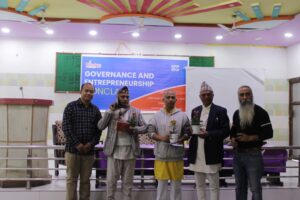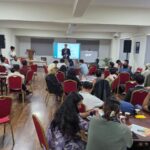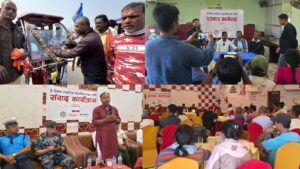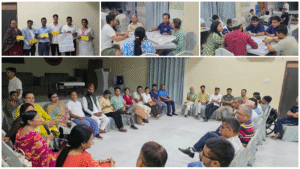

On January 4th, 2025, Bikalpa, an Alternative, with the support of CIPE International, hosted the One-day ‘Governance and Entrepreneurship Conclave’ at Hotel Shree Krishna in Biratnagar. The event aimed to foster discussions and understand the relationship between Governance and entrepreneurship. It also provided a platform for YPE fellows, Bikalpa fellows, and other participants to engage in meaningful conversations, exchange ideas, and learn from the experiences of successful entrepreneurs and experts.
During the session, speakers from different sectors joined the program which included interactive learning methods, networking, and Panel discussions which allowed participants to explore and share ideas about entrepreneurship and Governance. The program included the topics on Youth, Opportunity, and Entrepreneurship, Panel Discussion on Ensuring the Livelihood Opportunity of the E-rickshaw Drivers, Panel Discussion on Potentiality of Tourism in Koshi Province, Opportunity and Challenges in Health Sector of Koshi Province, Colloquium on Entrepreneurship and Youth, Governance and Accountability.
The session ‘Ensuring the Livelihood Opportunity of the E-rickshaw Drivers’ was moderated by Mr. Basanta Adhikari. The panelist for the session included Mr. Tithendra Neupane (Biratnagar Metroplitian City ward-11 Chairperson), Mr. Parul Chhetri (Civil Society Member) and Mr Bhagwan Basnet (Auto and E-Rickshaw Drivers’ Association). The discussion lasted for an hour and 30 minutes.
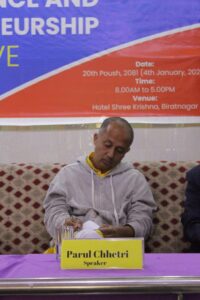
Mr. Parul Chhetri (Civil Society Member)
Mr. Parul Chhetri, who emphasized the socio-economic importance of city rickshaws and the challenges faced by their drivers. He highlighted that the issue of city rickshaws is not just a local concern but a national one. However, there has been little to no effort from the government or society to address it. In Biratnagar, Bikalpa is the sole organization consistently advocating for the rights and welfare of city rickshaw drivers. Mr. Chhetri stressed the need for collective action, urging everyone to raise their voices for the marginalized sections of society. He pointed out the lack of governmental engagement, mentioning that the Prime Minister and lawmakers have not yet addressed the issues affecting city rickshaw drivers, despite their direct link to the economic activity and livelihoods of low-income individuals.
Mr. Chhetri expressed disappointment that such a critical topic has never been discussed in the Parliament of Nepal. He criticized the government and political leaders for ignoring the struggles of hardworking, low-income individuals while rewarding others for their contributions. He urged policymakers, government officials, and city leaders to participate in sessions like this to understand the ground realities and be held accountable by the youth.
He proposed practical solutions, such as the provision of basic facilities like parking spaces, public toilets, drinking water, and charging stations, which would significantly improve the working conditions for e-rickshaw drivers. He also underscored that the government could resolve licensing and management issues promptly if it prioritized them. Concluding, Mr. Chhetri called for a more inclusive and equitable approach to city development, recognizing and supporting the contributions of marginalized groups like e-rickshaw drivers.
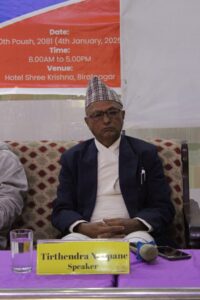
Tirthendra Neupane (Ward Chair Person)
City rickshaw is the major means of daily life. It is also the means of earning for the illiterate and low income people. Biratnagar metropolitan is trying best to manage and solve the problem raised from city rickshaw. We are frequently making discussion and meeting to know the appropriate number of city rickshaw and proper policy for biratnagar. There are problems for everyone including Traffic Police, rickshaw’s drivers, and even the conditions of roads.
Biratnagar Metropolitan city is going to give registration to 3000 city rickshaws in Biratnagr. Despite this, only around 2000 rickshaws have been registered in the office of metro. But if we see the rickshaws in the road of Biratnagar 7000 plus rickshaws run every day. The problem is more than 50% rickshaws registered themselves in rural municipality and when they don’t get enough income they come to the Biratnagar. Talking about the problems of license, I think Province government should formulate the laws and policies regarding this and same should be implemented to all the local levels. If the drivers are illiterate then also they need to have the license to drive rickshaws. Local government can manage only the route and provide the permit for city rickshaw. The laws and policies regarding the license and insurance for city rickshaws should be formulated at province level.
The rules and regulations for city rickshaws may differ from province to province. Along with the license facility it is also necessary to provide the insurance facility for city rickshaws and drivers. There must be coordination between traffic police, city rickshaws drivers and local people.
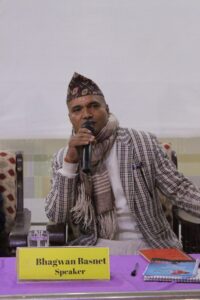
Bhagwan Basnet
The matter of livelihood is directly connected with the problems of city rickshaw in Biratnagar. We are trying from local to federal level to overcome the problem of city rickshaw. From the central level we have already decided that there will be no writing exam for C1 (city rickshaw) license and they can get their license by directly passing the trail. We are forcing transport ministry and District Traffic Police Office to implement the decision made from central level. I am advocating the issue of license in many programs and discussion but until and unless the victim (drivers of city rickshaws) raises their voice against the problem, this problem isn’t going to be solved.
The session concluded with a vibrant discussion, leaving participants with a clearer perspective on the role of e-rickshaw in the daily lives of commuters and issues faced by drivers.