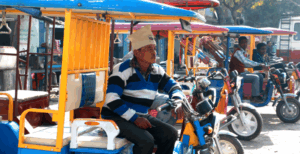

Nearly eight in ten e-rickshaws in Terai’s biggest cities are operating without a license, exposing drivers to financial ruin in accidents and leaving passengers without legal protection. A new survey of 963 drivers across Biratnagar, Itahari, Damak, Janakpur, Birgunj, Siddharthanagar, and Nepalgunj reveals deep-rooted educational, procedural, and enforcement gaps that keep the wheels turning in the shadows.
Figure 1:Pie chart showing unlicensed and licensed e-rickshaw driver

Note: Survey 2025, Bikalpa-an alternative
Of all drivers surveyed, 77.99% lacked a e-rickshaw license.The licensing gap is not uniform across the Terai’s urban centers; some cities are far worse than others. In Biratnagar, for instance, just 15.97% of e-rickshaw drivers hold a license, leaving more than eight in ten (84.03%) operating without one. The situation is only marginally better in Damak (20.63% licensed) and Janakpur (19.08% licensed), where the overwhelming majority remain outside the formal system.
Ithari shows a slightly higher licensing rate (26% licensed), yet nearly three-quarters still operate informally. Birgunj stands out as the most compliant city in the survey, with 42.03% of drivers licensed, though even here, a majority (57.97%) remain unlicensed. Siddharthanagar follows closely behind with 38% licensed, suggesting stronger uptake compared to other cities.
Figure 2:Bar chart showing % of unlicensed e-rickshaw drivers across the major Terai cities of Nepal

Note: Survey 2025, Bikalpa-an alternative
Nepalgunj presents the most alarming case: only 3.97% of its e-rickshaw drivers hold a license, meaning a staggering 96.03% operate without legal authorization. This near-total absence of licensing points to deep-rooted challenges in regulatory outreach, accessibility, or driver engagement in the city.
Figure 3: Line chart showing licensing rate by years of experience

Note: Survey 2025, Bikalpa-an alternative
The survey also found a strong correlation between driving experience and licensing status. Among drivers with less than six months on the job, only 9.7% had a license, while the proportion gradually increased with experience, 14.67% for those with six months to one year, 21.63% for two to three years, 26.88% for three to five years, and 32.24% for more than five years. However, even in the most experienced group, over two-thirds (67.76%) remained unlicensed. This pattern suggests that while experience slightly improves the likelihood of obtaining a license, structural and procedural barriers persist regardless of how long drivers have been in the profession.
Education emerges as a critical bottleneck in the licensing process. Nearly nine in ten drivers (89.37%) who never attended school remain unlicensed, and the figure is nearly as high (84.72%) among those who studied but did not complete primary school. Even drivers who passed primary level (grades 1–5) face similar odds, with 85.71% operating without a license. Licensing rates improve with higher education; 32.19% for those completing lower secondary (grades 6–8), 47.62% for SLC/SEE graduates, but even in these groups, a majority remain outside the licensing system. Since obtaining a license requires passing a written exam, low educational attainment sharply reduces the chances of compliance, creating a structural disadvantage for the majority of drivers.
Table 1: Licensing rate by education level
| Education level | Licensed | Unlicensed | ||
| Cannot read or write / Didn’t go to school | 27 | 10.63% | 227 | 89.37% |
| Some education (did not complete primary level) | 22 | 15.28% | 122 | 84.72% |
| Completed primary level (grades 1-5) | 23 | 14.29% | 138 | 85.71% |
| Completed lower secondary level (grades 6-8) | 47 | 32.19% | 99 | 67.81% |
| Did not complete secondary level (grades 9-10) | 47 | 32.19% | 99 | 67.81% |
| Completed SEE/SLC | 30 | 47.62% | 33 | 52.38% |
| Completed higher secondary level (+2/grades 11-12) | 15 | 34.09% | 29 | 65.91% |
| Bachelor’s degree | 1 | 33.33% | 2 | 66.67% |
Note: Survey 2025, Bikalpa-an alternative
Recognizing that the written exam requirement disproportionately excludes drivers with low educational attainment, the Koshi Province government has addressed the educational barriers that keep many drivers unlicensed, the Koshi Province government amended the Provincial Vehicle and Traffic Management Regulations to Provincial Vehicle and Transport Management (Second Amendment) Regulations, 2082. In the section concerning amendments to Rule 25 of the original regulations, the following changes were made: The term “e-rickshaw” has been added after the word “power tiller” in sub-rule (5). Sub-rule (5a) has been added, which states that examinees for the driving license test who participate in or are exempt from the written exam must receive a training session on traffic signs, road safety, vehicle mechanics, and related laws and regulations. This session must be between 30 minutes and one hour long. Attendance records for this training must be kept with the practical exam minutes. However, for the e-rickshaw exam, a system will be developed and implemented electronically according to these regulations.
This shift aims to reduce the structural disadvantage faced by low-educated drivers and improve formalization rates, potentially setting a precedent for other provinces to follow. By focusing on practical understanding over written tests, the regulations promise a more inclusive and efficient licensing system. Koshi’s approach could serve as a valuable example for other provinces, encouraging them to streamline their licensing processes and adopt more inclusive, practical training methods. Such reforms have the potential to increase compliance, enhance road safety, and protect both drivers and passengers across Nepal.
E-rickshaw driving is more than a job: for most respondents, it is the sole means of supporting their families.An analysis of dependency ratios further underscores the barriers to formalization. The survey shows a clear pattern: Among drivers supporting 1–2 dependents, only 20.31% hold a license, while 79.69% remain unlicensed.For those with 3–4 dependents, licensing improves slightly to 24.68%, but 75.32% still operate without one.Drivers with five or more dependents show the highest licensing rate (31.48%), yet 68.52% remain outside the formal system. Although the data suggests that drivers with larger households are somewhat more likely to obtain a license, possibly due to greater financial responsibility, the overall rates remain low across all groups. This reinforces the finding that structural and procedural obstacles to licensing affect drivers regardless of family size.
Figure 4: Bar chart showing licensing rate by no. of dependents

Note: Survey 2025, Bikalpa-an alternative
The Human Cost of Being Unlicensed
Without a license, they are ineligible to claim third party insurance coverage. In the event of an accident, this exclusion forces them to absorb the full cost of medical treatment, vehicle repairs, and associated liabilities, amounting to sums that can exceed several months of their earnings and putting themself in a financial burden. Even more alarming is that, the resulting financial shock cascades through the household in multiple dimensions. First, educational attainment is compromised as families may withdraw children from school to conserve resources or enlist them in income‐generating activities, undermining long‐term human capital formation. Second, routine healthcare and nutritional needs are deprioritized in favor of servicing acute medical debts, elevating the risk of chronic illness and developmental deficits among dependents. Third, the necessity of securing emergency funds often compels households to rely on high‐interest informal loans, thereby entrenching them in intergenerational cycles of indebtedness. Finally, the psychosocial burden of economic insecurity which manifests in chronic stress, anxiety, and diminished parental capacity can erode familial cohesion and impede the emotional and cognitive development of children. Collectively, these dynamics exacerbate poverty, impede social mobility, and perpetuate structural inequities across successive generations.